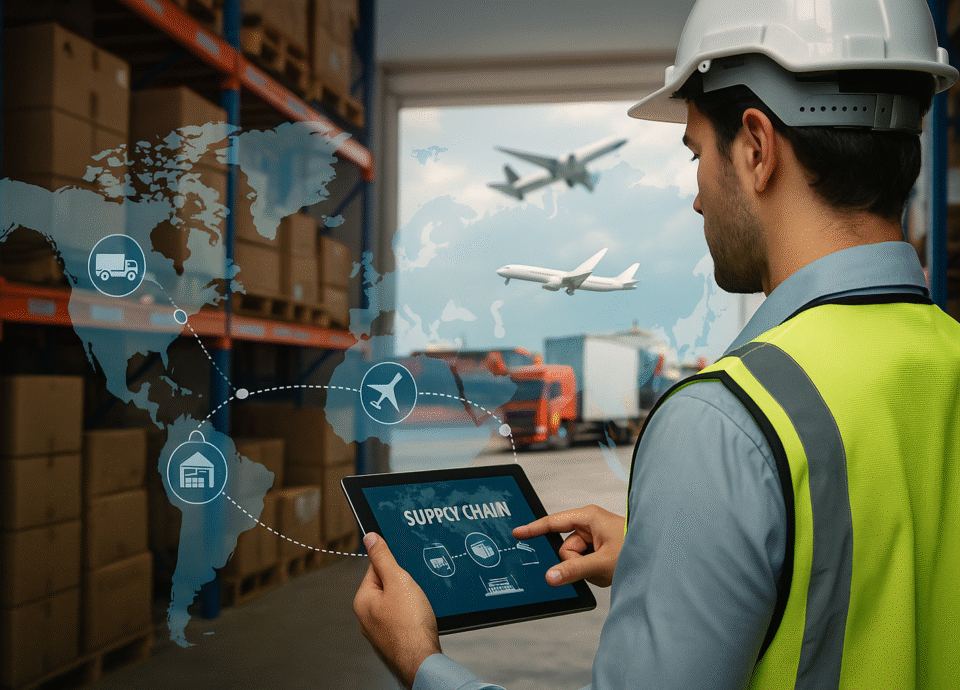

Introduction : In today’s interconnected world, the backbone of global commerce lies in logistics hubs where air, road, and sea seamlessly converge to keep goods in motion.
The image above perfectly illustrates this synergy: a confident logistics professional standing amid a bustling yard of containers, with a truck ready for dispatch, a forklift in motion, and an aircraft soaring overhead. It’s a visual definition of what modern supply chains stand for — speed, coordination, and reliability.
This blog takes you behind the scenes of how integrated freight hubs operate, the systems that keep them efficient, and the human expertise that makes it all work flawlessly.
1. The Power of Integrated Freight Hubs : Integrated freight hubs serve as the central link connecting global supply routes. By bringing multiple modes of transport — trucks, ships, trains, and planes — into one coordinated network, these hubs minimize transit delays and maximize efficiency.
Why they matter:
-
Centralized control reduces downtime and improves cargo turnover.
-
Strategic positioning near ports and airports enables faster cross-border movements.
-
Streamlined communication between carriers and warehouses enhances reliability.
Pro Tip: Map your primary logistics lanes and identify a regional hub that can reduce lead time by at least 15%. It’s a small shift that can deliver a big competitive edge.
2. Synchronizing Multimodal Operations : Logistics success is built on timing. At an integrated hub, every minute counts — from when a truck arrives at the gate to when a pallet is loaded onto a plane.
Key coordination strategies:
-
Slot-based scheduling for trucks to prevent yard congestion.
-
Prioritization of time-sensitive or high-value cargo.
-
Continuous real-time updates between air, road, and warehousing teams.
Example: A single delay in truck arrival can ripple through the system, missing a flight window and causing costly demurrage. Smart hubs use predictive scheduling to anticipate these bottlenecks before they occur.
3. Efficient Yard and Container Management : The yard is the true operational battlefield. Smooth container movement and efficient space utilization define a hub’s productivity.
Best practices:
-
Adopt digital yard mapping to monitor every container’s live position.
-
Standardize stacking methods to allow rapid retrieval.
-
Maintain well-serviced forklifts and reach stackers to avoid breakdowns.
Quick Fix: Conduct daily yard audits to identify idle assets, misplaced containers, and empty trip cycles — the hidden costs of inefficiency.
4. People First: The Human Core of Logistics : Behind every efficient operation is a team of trained professionals who understand the rhythm of logistics. From forklift drivers to dispatch coordinators, human precision is what turns systems into success.
Workforce essentials:
-
Regular skill-building and equipment handling certifications.
-
Shift-based safety briefings and proper PPE enforcement.
-
Performance incentives tied to accuracy, safety, and throughput.
Insight: Technology accelerates logistics — but human intelligence sustains it. A motivated, safety-aware team outperforms any automation system in the long run.
5. Technology That Drives Performance : Smart hubs rely on integrated digital systems — not complex, disconnected tools. The goal is seamless visibility from entry to exit.
Essential technologies:
-
Yard Management Systems (YMS): Track container flow in real-time.
-
Transportation Management Systems (TMS): Optimize route planning and fleet scheduling.
-
Handheld Scanners & IoT Sensors: Enable live tracking and instant documentation.
Pro Tip: Start with one unified visibility dashboard that displays live gate-in/gate-out status, truck ETAs, and container health metrics.
6. Sustainability Meets Efficiency : Sustainable logistics is no longer optional — it’s a strategic necessity. Freight hubs are now aligning operational efficiency with environmental responsibility.
Green initiatives that make an impact:
-
Using electric or hybrid yard tractors to cut fuel costs.
-
Consolidating LTL shipments into full truckloads to reduce emissions.
-
Installing solar panels or LED lighting to lower energy consumption.
Case Insight: One integrated hub in Rotterdam reduced carbon emissions by 22% within a year by switching to electric forklifts and implementing AI-based truck routing.
7. Building a Resilient, Future-Ready Hub : Every logistics hub faces challenges — weather disruptions, labor shortages, or global trade delays. Resilience is built through proactive strategy and flexible planning.
Key resilience levers:
-
Dual sourcing for critical routes or carriers.
-
Maintaining safety stock for high-demand goods.
-
Running quarterly “stress test” simulations for worst-case scenarios.
Smart Move: Create a 24-hour crisis response protocol that enables quick rerouting and decision-making when supply chains are under pressure.
Conclusion : From ground to sky, art logistics is a symphony of precision — where security meets sensitivity, and technology meets artistry. Whether it’s a centuries-old canvas or a modern sculpture, every piece deserves a journey as carefully crafted as the work itself.
Because in art logistics, we don’t just move objects — we move stories, legacies, and emotion across the world.